
How trees can turn down the heat in Britain's cities.

Understanding Urban Heat Island Effect and the vital role of urban trees.
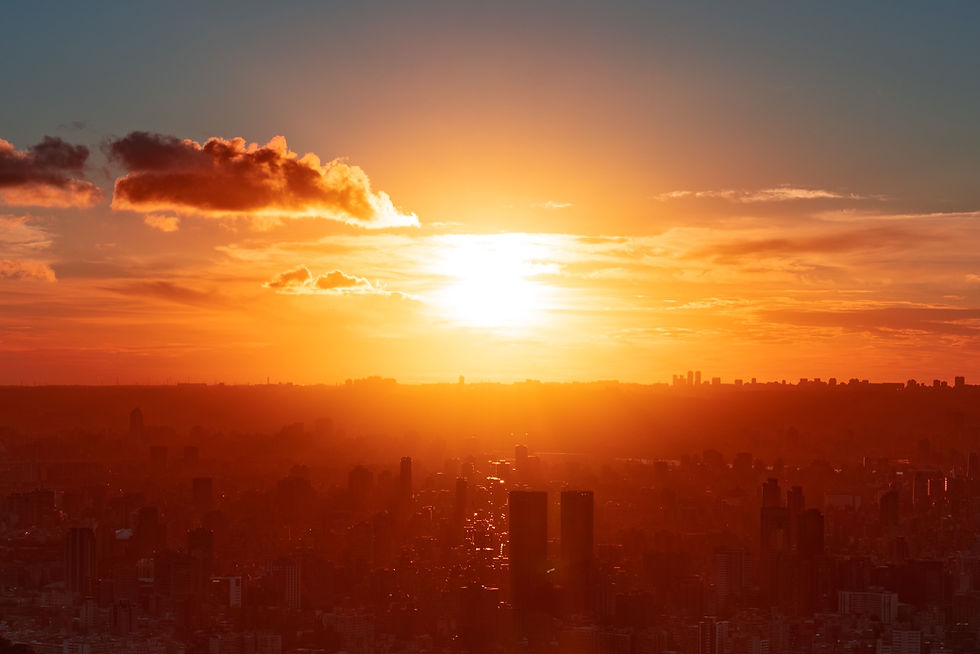
Urban Heat Island Effect (UHI) is a phenomenon whereby towns and cities are often warmer than the surrounding landscape. Buildings, roads and pavements absorb and store solar radiation during the day, then release some of that heat after sunset. This effect is compounded by various factors including the density of buildings, the materials used in the urban environments, reduced vegetation and soil moisture, limited airflow, and heat generated by human activity. Because heat is stored and released slowly this results in higher ambient temperatures that are particularly pronounced after dark.
In London, for example, modelling has found average summer midnight temperatures in the city to be around 4°C higher than the surrounding countryside, with even larger differences possible during hot nights. The size of the urban heat island varies considerably, however, depending on weather, time of day, the form and layout of the city, and location.
The consequences are not simply theoretical. A 2025 study in The Lancet Planetary Health estimated that around 400 deaths in Greater London during summer 2018 were attributable to the additional heat associated with UHI.
This matters even more given that urban heat is occurring against a background of a warming climate and increasingly frequent periods of extreme heat. The summer of 2026 is a case in point: the UK recorded 33 days above 30oC, while temperatures reached 35oC in May, June, July and August for the first time on record.
More than 80% of the UK population lives in towns and cities, and that number is still rising. For these people, this combination of background warming and local urban heating can increase exposure to heat stress. The challenge is therefore not simply to make cities greener, but to design urban environments that can remain liveable as conditions change.
Trees can provide local cooling
Trees are one of the most effective forms of urban vegetation for reducing exposure to heat, particularly where people are directly exposed to the sun.
Their first cooling mechanism is shade. A tree canopy intercepts solar radiation before it reaches roads, paving, walls and other surfaces. This reduces the amount of energy absorbed by those surfaces and, consequently, the amount of heat they can release back into the surrounding environment.
Trees also cool through evapotranspiration. Water drawn through the tree is released through the leaves, and this process uses energy from the surrounding environment. In effect, some of the available energy is diverted into moving water rather than heating the air and surfaces around the tree. Research consistently identifies shading and evapotranspiration as the principal mechanisms through which urban vegetation reduces heat.
Heat maps produced by Friends of the Earth across five major English cities have demonstrated that areas with more trees and green space can be up to 5°C cooler than areas without. The Food and Agriculture Organization of the United Nations cites evidence that strategically placed urban trees can cool the air by up to 8°C under the right conditions.
The cooling effect, therefore, can be substantial. But it isn’t uniform. If depends on factors including canopy size and density, tree characteristics, available water, urban size and form, and the local climate.
This is important because it means that simply counting trees is not enough. Where trees are planted, how much canopy they provide, and which species are selected all influence the cooling benefit they will deliver.
The right tree matters
The characteristics of an individual tree influence its ability to provide shade and cooling. Leaf area, canopy density, crown form and transpiration characteristics can all affect performance.
But there is another consideration that becomes increasingly important as the climate changes: the tree itself needs to survive and perform in the conditions where it is planted.
A species that provides excellent canopy cover today is of limited value if it struggles with the hotter drier conditions expected later in the century. Conversely, a species with strong climate resilience may not necessarily be the best choice for every street, site or cooling objective.
Recent research comparing evidence from 182 studies across 110 cities demonstrated just how strongly cooling performance is influenced by the interaction between tree traits, urban morphology and background climate.
For landscape architects, urban planners and engineers, this makes tree selection a much more sophisticated task than choosing a species from a traditional planting list. The challenge is to determine which species is likely to establish, survive and provide the desired benefits in a particular place and under future climate conditions.
Designing for the city of the future.
That's the logic Palette applies to shade and cooling potential which is one of its core species filters.
The platform brings together location-specific information and scientific research to help users consider factors including shade and cooling potential, biodiversity, air-pollution and future climate suitability.
Its species recommendations draw on climate-resilient research developed with the Royal Botanic Gardens, Kew helping to identify trees that are better suited to the conditions they are likely to face in the decades ahead.
As heatwaves like the summer of 2026 become the norm and not the exception, the species selected to shade a street will have increasingly important role to play. However, the goal is more complex than simply more trees in cities. This is about the right trees, in the right place, designed to keep delivering their benefits as the climate changes.


Comments